This was a quote from "The Locater" on Oprah Winfrey. This is a person who helps locate biological family members. It resonated with me, as I am searching for that peace, a peace adopted children often crave. Does this mean an adopted child does not love their adopted family? Should the adopted family feel threatened? I can not answer for all adopted children..........for me, no, my family should not feel threatened. I love them and know I am loved.
Who am I?
My father's name is John Robert Wills. He was married to my mom (Cheryl Crabbs-maiden name) approximately in 1971-1974'ish. I was the first born child of this union. I have a brother born 2 years after me - John Robert Wills Jr. - we called him Johnny. I have vague memories of my father. I know he was a tall, slender man with brown hair. I can not even remember his eye color. I remember feeling loved with him. My grandfather used to tell me stories about how much my father loved me, how I was the apple of his eye and he cuddled with me. I tend to believe this due to the lingering nurturing memories I have of him.
My last memory of my father was shortly before we went into foster care. I had not seen him in several years, and he showed up at our house. I did not recognize him or believe him when he said he was my dad. I made him show proof of his name. I still remember him giving me his driver's license with his name on it before I believed it. I was 8 years-old and demanded proof of his identity. I was a brave and bold little girl! My older brother was so afraid of my father, he locked the door to the house to ensure my father could not come inside, thus I was locked outside with him. I did not care. I thought this man was going to rescue me. I remember feeling free and experiencing hope....it was a novel experience and I wanted to hold onto this emotion for as long as I could. My father told me he wanted my brother and me to live with him. I believe he had his wife with him, but I could not tell you if this is a true memory, as everything in my being was focused on him and freedom.
My father left to talk with my step-father. Whatever transpired between my step-father and my father severed my chance for freedom and I never saw my father again. He did not come to say good-bye. He left me and took the hope with him. I wonder if he cared or understood the magnitude of his loss. I would like to ask him. The final nail in the relationship occurred when my parents rights were officially severed. My father did not show up to court. He did not fight it. He simply gave his parental rights away.
Disposable child
I learned on that day I was not loved, not enough to save or treasure. I was disposable. I often wondered if people would even notice if we were gone. Could we disappear and nobody notice? Would people care? Would they be happy or relieved if we were gone? Were we a reminder of mistakes?
I was reminded every time I looked in the mirror of my mother. I was not identical to her, but resembled her very much in my hair, eye color and build. This has been very difficult to live with - because I look like her does this mean I am going to be crazy too? Does this mean I will go from man to man looking for that elusive happiness that will never arrive because the person is not happy with herself? Will I spend my life in and out of hospitals? Will I be a horrible mother?
Differences
I am taller than my mother, a gift from my very tall father. I am more emotionally intelligent than my parents. I am more resilient, as well. When my life gets tough, I don't quit, like both of them did. I am not a quitter.
Proof of existence
At the same time, I always felt a need to prove myself, to be worthy of my existence. "See, look at how many degrees I have. I am smart." "Look, I have been married 17 years. My mother couldn't stay married 5 years." "I love my children. My parents loved themselves."
And.........just like my mother always looking for happiness outside of herself I did not find happiness this way either. I could have helped thousands of children work through their pain and it would not extinguish my pain. I was the only person who could work through my childhood and it had to come from within. I had a very good therapist who guided me on this path and now I truly realize.....
I AM NOT MY MOTHER!
My family destroyed my ego, they crushed it and hurt a child in more ways than even I can describe, but I survived the pain. I re-built my ego. My goal now is to thrive and move forward, to find the peace I long for........
My father's name is John Robert Wills. He was in the United States Army in 1972 and was stationed at Fort Riley, KS. He moved back to his home state of either New Mexico or Arizona after he divorced. If anyone reading this knows anyone of this name please feel free to let him know a woman who could possible be his long-lost daughter would like to meet him. I would like to know my history - I would like to know what he looked like, what his family looked like. I would like to have all of the biological pieces.
My name is Angela Irene Wills - Bush - Watson. I am a beautiful person. I have three amazing siblings:
Lisa Jane Martin - 40 years old
Anthony Martin - 42 years old
John Robert Wills - 36 years old
these are their biological names, not adopted... I miss you and love you!
Saturday, May 29, 2010


Sunday, May 23, 2010
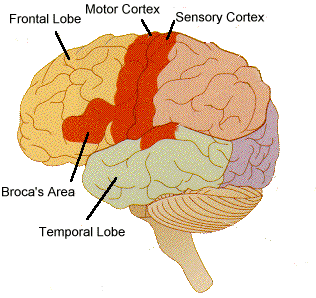
Interesting article on neurological functioning in traumatized children
Childhood PTSD Linked to Brain Failure
By Rick Nauert PhD Senior News Editor
Reviewed by John M. Grohol, Psy.D. on December 9, 2009
Childhood PTSD Linked to Brain Failure In a new study, Stanford University scientists have demonstrated that psychological trauma damages a child’s brain.
The study gives the first direct evidence that children with symptoms of post-traumatic stress suffer poor function of the hippocampus, a brain structure that stores and retrieves memories.
Experts believe the research helps explain why traumatized children behave as they do and could improve treatments for these kids.
“The brain doesn’t divide between biology and psychology,” said Packard Children’s child psychiatrist Victor Carrion, MD, the primary author of the new research.
“We can use the knowledge we get from understanding brain function to improve the psychology of the individual and vice versa.”
Extreme stressors such as experiencing abuse or witnessing violence can make children isolate themselves from family and friends, feel disconnected from reality, experience intrusive thoughts about the trauma and struggle in school.
“Post-traumatic stress is not only about the traumatic memories; it really affects daily living,” said Carrion, who is an associate professor of child and adolescent psychiatry at the School of Medicine and director of Stanford’s early life stress research program.
The research is published online in the Journal of Pediatric Psychology.
The findings could be an important step toward better monitoring of PTSD treatments, which include psychotherapy techniques such as teaching relaxation exercises, helping children to construct a cohesive story about the traumatic event and helping them learn to cope with reminders of the trauma. Right now, psychologists assess such treatments by looking for improvements in symptoms, but that’s a problem because the symptoms can fluctuate from day to day.
“That method has the disadvantage that we don’t know what’s happening at the neural level,” Carrion said.
To observe how kids’ brains work after trauma, Carrion’s team used functional magnetic resonance imaging to compare 16 young people who had PTSD symptoms with a control group of 11 normal youths.
The scientists scanned the brains of the 10- to 17-year-old subjects during a simple test of verbal memory. Subjects read a list of words, then saw a similar list with new words added, and were asked which terms were present on the original list.
The hippocampus worked equally well in stressed and control subjects when the word list was first introduced. However, subjects with PTSD symptoms made more errors on the recall part of the test and showed less hippocampus activity than control subjects doing the same task.
Subjects with the worst hippocampus function were also most likely to experience a specific set of PTSD symptoms: Such impairment of the hippocampus was strongly correlated with “avoidance and numbing” symptoms of PTSD, including difficulty remembering the trauma, feeling cut off from others and lack of emotion.
Parents and other caregivers may find the new discoveries useful as they tend to traumatized children, Carrion said, particularly when children respond to trauma by withdrawing from people who are trying to help. Parents may sometimes misinterpret this behavior as a child’s attempt to retaliate, when it actually represents an overload of the brain’s normal mechanism for handling fear.
“When parents understand that PTSD is real, they don’t take it as personally,” he said. “They become more available to their kids. That’s good because the kids need them.”
In the future, physicians and scientists may be able to use fMRI scans of the hippocampus to identify children who are at high risk of PTSD after mass catastrophes, added Carrion, who has consulted on response teams for natural disasters such as Hurricane Katrina and the February 2009 wildfires in southeastern Australia.
However, larger studies of brain activity in pediatric PTSD are still needed to give a more detailed understanding of the disorder.
It’s already clear that untreated PTSD can interfere with a child’s normal brain development and increase the risk of other psychiatric conditions such as depression and substance abuse, Carrion concluded.
“Early intervention is critical for children with post-traumatic stress,” he said.
source: Stanford University
By Rick Nauert PhD Senior News Editor
Reviewed by John M. Grohol, Psy.D. on December 9, 2009
Childhood PTSD Linked to Brain Failure In a new study, Stanford University scientists have demonstrated that psychological trauma damages a child’s brain.
The study gives the first direct evidence that children with symptoms of post-traumatic stress suffer poor function of the hippocampus, a brain structure that stores and retrieves memories.
Experts believe the research helps explain why traumatized children behave as they do and could improve treatments for these kids.
“The brain doesn’t divide between biology and psychology,” said Packard Children’s child psychiatrist Victor Carrion, MD, the primary author of the new research.
“We can use the knowledge we get from understanding brain function to improve the psychology of the individual and vice versa.”
Extreme stressors such as experiencing abuse or witnessing violence can make children isolate themselves from family and friends, feel disconnected from reality, experience intrusive thoughts about the trauma and struggle in school.
“Post-traumatic stress is not only about the traumatic memories; it really affects daily living,” said Carrion, who is an associate professor of child and adolescent psychiatry at the School of Medicine and director of Stanford’s early life stress research program.
The research is published online in the Journal of Pediatric Psychology.
The findings could be an important step toward better monitoring of PTSD treatments, which include psychotherapy techniques such as teaching relaxation exercises, helping children to construct a cohesive story about the traumatic event and helping them learn to cope with reminders of the trauma. Right now, psychologists assess such treatments by looking for improvements in symptoms, but that’s a problem because the symptoms can fluctuate from day to day.
“That method has the disadvantage that we don’t know what’s happening at the neural level,” Carrion said.
To observe how kids’ brains work after trauma, Carrion’s team used functional magnetic resonance imaging to compare 16 young people who had PTSD symptoms with a control group of 11 normal youths.
The scientists scanned the brains of the 10- to 17-year-old subjects during a simple test of verbal memory. Subjects read a list of words, then saw a similar list with new words added, and were asked which terms were present on the original list.
The hippocampus worked equally well in stressed and control subjects when the word list was first introduced. However, subjects with PTSD symptoms made more errors on the recall part of the test and showed less hippocampus activity than control subjects doing the same task.
Subjects with the worst hippocampus function were also most likely to experience a specific set of PTSD symptoms: Such impairment of the hippocampus was strongly correlated with “avoidance and numbing” symptoms of PTSD, including difficulty remembering the trauma, feeling cut off from others and lack of emotion.
Parents and other caregivers may find the new discoveries useful as they tend to traumatized children, Carrion said, particularly when children respond to trauma by withdrawing from people who are trying to help. Parents may sometimes misinterpret this behavior as a child’s attempt to retaliate, when it actually represents an overload of the brain’s normal mechanism for handling fear.
“When parents understand that PTSD is real, they don’t take it as personally,” he said. “They become more available to their kids. That’s good because the kids need them.”
In the future, physicians and scientists may be able to use fMRI scans of the hippocampus to identify children who are at high risk of PTSD after mass catastrophes, added Carrion, who has consulted on response teams for natural disasters such as Hurricane Katrina and the February 2009 wildfires in southeastern Australia.
However, larger studies of brain activity in pediatric PTSD are still needed to give a more detailed understanding of the disorder.
It’s already clear that untreated PTSD can interfere with a child’s normal brain development and increase the risk of other psychiatric conditions such as depression and substance abuse, Carrion concluded.
“Early intervention is critical for children with post-traumatic stress,” he said.
source: Stanford University
Thursday, May 20, 2010
garden
I wanted everyone to know I am sorry I didn't blog last night I have been transfixed by my vegetable garden! It is nurturing my soul right now, and I find I run out of time!
Tuesday, May 18, 2010
foster care frustrations
*I am trying to blog every day about my thoughts, sort of a thought for the day. It won'tgo in a specific order. I am sorry if it feels disjointed. I want this process to be as organic as possible, not clinical instead emotional. Now, to the topic for today..
I am reminded often of the continuing struggle children in foster care have in society. Our society has made and continues to make progress in understanding the impact trauma has on a brain and behaviors. As a culture, we are still lacking in the implementation of the research. How many times can a child be told to stop utilizing maladaptive or negative coping skills when the child can't turn the alarm signals off in their brain because of the trauma? We can not expect a child to improve until the child feels safe, trusts the adults and effectively processes the traumas.
Also, so many children continue to slip through the system because instead of anger outbursts the child excels. These children are the "golden children". They have good grades, often excel at anything they try, and fit in well with peers and family. this sounds good, right? Yes and no. Again, there is research on this, if you want to read it.
Golden child?
Take myself for example: good grades, excelled at any sport I tried, good peer relationships and good social skills. I still remember the discussion with my last social worker (revolving door over my years in foster care, sporadic contact, often didn't even remember the name of the worker).. The worker reminded me to be good and how important it was to put "your best face forward". "This could be your last chance.". I knew I was almost a teenager, and it was probably my last chance. I wanted my family to be proud of me and not give me back.
Description of me
My foster care worker knew me so well she told my parents I was a sandy-blonde child who was very affectionate! I was a flaming red-head who most definitely was not affectionate, and did NOT trust adults!
My personal mask
Unfortunately, this created a mask. I couldn't keep it from cracking. I drank to cope. At first, I drank to fit in with my peers. It didn't impact my grades or sports - I wouldn't allow that. By my senior year the drinking was daily at times, drinking at school, binge drinking on the weekends. It was so bad my coaches stepped in and discussed having an intervention! When I drank I felt free, a freedom I never had sober, when I was constantly worrying about how to act and succeed. When I drank I could say whatever I wanted and blame it on the alcohol.
I stopped drinking regularly without need for help. I did have binge drinking at times for several years, but haven't had more than an occasional drink for almost ten years!
Pressure
What is the point of my story? Children adopted from foster care understand temporary and are taught to act a certain way to ensure staying in a home. Imagine the pressure of behaving all the time or being given away. It is hard enough for a child to behave when going to grandma's for the day, much less every day. For myself, this is how it felt for most of my childhood and adult years. Foster care scarred me, and unfortunately continues to scar other children. One only has to watch the news to learn..
Sick joke of the day: don't have a good joke today (as if yesterday's joke was funny)
How did the two vampires finish the race? They finished neck and neck! -provided courtesy of my 9 year-old son!
DISCLAIMER: I am describing my experiences and emotions, and mine alone. My blog does not give advice or take the place of therapy. :)
I am reminded often of the continuing struggle children in foster care have in society. Our society has made and continues to make progress in understanding the impact trauma has on a brain and behaviors. As a culture, we are still lacking in the implementation of the research. How many times can a child be told to stop utilizing maladaptive or negative coping skills when the child can't turn the alarm signals off in their brain because of the trauma? We can not expect a child to improve until the child feels safe, trusts the adults and effectively processes the traumas.
Also, so many children continue to slip through the system because instead of anger outbursts the child excels. These children are the "golden children". They have good grades, often excel at anything they try, and fit in well with peers and family. this sounds good, right? Yes and no. Again, there is research on this, if you want to read it.
Golden child?
Take myself for example: good grades, excelled at any sport I tried, good peer relationships and good social skills. I still remember the discussion with my last social worker (revolving door over my years in foster care, sporadic contact, often didn't even remember the name of the worker).. The worker reminded me to be good and how important it was to put "your best face forward". "This could be your last chance.". I knew I was almost a teenager, and it was probably my last chance. I wanted my family to be proud of me and not give me back.
Description of me
My foster care worker knew me so well she told my parents I was a sandy-blonde child who was very affectionate! I was a flaming red-head who most definitely was not affectionate, and did NOT trust adults!
My personal mask
Unfortunately, this created a mask. I couldn't keep it from cracking. I drank to cope. At first, I drank to fit in with my peers. It didn't impact my grades or sports - I wouldn't allow that. By my senior year the drinking was daily at times, drinking at school, binge drinking on the weekends. It was so bad my coaches stepped in and discussed having an intervention! When I drank I felt free, a freedom I never had sober, when I was constantly worrying about how to act and succeed. When I drank I could say whatever I wanted and blame it on the alcohol.
I stopped drinking regularly without need for help. I did have binge drinking at times for several years, but haven't had more than an occasional drink for almost ten years!
Pressure
What is the point of my story? Children adopted from foster care understand temporary and are taught to act a certain way to ensure staying in a home. Imagine the pressure of behaving all the time or being given away. It is hard enough for a child to behave when going to grandma's for the day, much less every day. For myself, this is how it felt for most of my childhood and adult years. Foster care scarred me, and unfortunately continues to scar other children. One only has to watch the news to learn..
Sick joke of the day: don't have a good joke today (as if yesterday's joke was funny)
How did the two vampires finish the race? They finished neck and neck! -provided courtesy of my 9 year-old son!
DISCLAIMER: I am describing my experiences and emotions, and mine alone. My blog does not give advice or take the place of therapy. :)
Monday, May 17, 2010
a new day
It is a new day, factually and metaphorically. I am getting feedback from families who have adopted - parents, children and even grandparents. By no means do I feel as if I speak for all adopted children, but many adopted children do share similar traits as well and similar emotions, especially children who are adopted at an older age. If this blog helps people feel a common belonging or helps adoptive families have greater understanding of each other it will be well worth the tears shed when writing it.
I feel lighter emotionally today, lighter than I have felt in years. It is from mentally letting go and acknowledging the losses and loneliness. By acknowledging these emotions I have also given myself the freedom to look at the love from my adoptive family and not feel guilty.
Why would an adoptive person feel guilty for loving the family that adopted him/her? It is as simple and complex as feeling unworthy. I constantly think "Why me?". Why was I adopted? I was not loved by my birth mother. I was not loved by my foster parents, at least not enough to be adopted. Also, remember I had one adoption fail. Why would a family love me? Will they stop loving me? I have to be prepared for that possibility, so when it happens I am strong. This is a common trait with children adopted from a state system. These are children who have been taken or tossed away, both traumatic. There is immense research on this now....not so much in 1980's. This will be discussed in a different blog.
My adoptive parents did not know how damaged I was and I didn't know how to express this to them. We all were blind and walked through it as best as we could, and my mom and I (my father passed away 2 years ago) continue to navigate this family as best as we can.
I, For my part, am going to work on trusting in my family's love for me and begin the process of not looking for the metaphorical shoe to drop. I won't lie and say I am going to stop right away. This would not be genuine. One can't erase cognitive thinking errors overnight, especially when a person is an adult (it takes longer to change).
If you have or are in the process of adopting a child please understand the fragility of the soul you are adding to your life. The soul is wounded and may be afraid to show you and may be waiting for you to give up, and will react to EVERYTHING. Emotion coaching is very helpful to navigate this - just a helpful parenting tip!
Sick, twisted Joke of the day: what do you call either a red-headed stepchild or red-headed foster child? Answer: me! Get it? I am a red-head and was both a step-child and foster child! The horrible jokes I endured! I also was in campfire girls - joke "Why did Angie join Campfire girls? They needed a fire!". :)
I feel lighter emotionally today, lighter than I have felt in years. It is from mentally letting go and acknowledging the losses and loneliness. By acknowledging these emotions I have also given myself the freedom to look at the love from my adoptive family and not feel guilty.
Why would an adoptive person feel guilty for loving the family that adopted him/her? It is as simple and complex as feeling unworthy. I constantly think "Why me?". Why was I adopted? I was not loved by my birth mother. I was not loved by my foster parents, at least not enough to be adopted. Also, remember I had one adoption fail. Why would a family love me? Will they stop loving me? I have to be prepared for that possibility, so when it happens I am strong. This is a common trait with children adopted from a state system. These are children who have been taken or tossed away, both traumatic. There is immense research on this now....not so much in 1980's. This will be discussed in a different blog.
My adoptive parents did not know how damaged I was and I didn't know how to express this to them. We all were blind and walked through it as best as we could, and my mom and I (my father passed away 2 years ago) continue to navigate this family as best as we can.
I, For my part, am going to work on trusting in my family's love for me and begin the process of not looking for the metaphorical shoe to drop. I won't lie and say I am going to stop right away. This would not be genuine. One can't erase cognitive thinking errors overnight, especially when a person is an adult (it takes longer to change).
If you have or are in the process of adopting a child please understand the fragility of the soul you are adding to your life. The soul is wounded and may be afraid to show you and may be waiting for you to give up, and will react to EVERYTHING. Emotion coaching is very helpful to navigate this - just a helpful parenting tip!
Sick, twisted Joke of the day: what do you call either a red-headed stepchild or red-headed foster child? Answer: me! Get it? I am a red-head and was both a step-child and foster child! The horrible jokes I endured! I also was in campfire girls - joke "Why did Angie join Campfire girls? They needed a fire!". :)
Sunday, May 16, 2010
Don't shake the pop!
I often wonder how to process my emotions and feelings without hurting others. I tend to stuff my feelings and than like a pop that has been shaken up I explode, and it never comes out correct. I am not going to do this anymore. I am going to express myself and own my feelings, right or wrong, they are mine!
SEPARATION
I miss my family. I miss having a close connections with brothers and sisters and nieces and nephews. I miss looking into someone's face and seeing a piece of me. It is harder the older I get to not have the biological component in my life. I see myself in my children. I see my brothers and sister in them too. I long to be able to tell them "Look at Conner, he has your eyes and he laughs like you did when you were his age. I remember us when we were children through my children."
I can tell this to my adopted family and I do talk to my mom about it, as she has met my biological siblings on a few occasions. She listens but can not understand the emotions, as truly only someone adopted can understand.
LONELINESS
I am lonely. I have several adopted siblings and all of the extended family. They were all grown and out of the house when I was adopted. I love them and we get angry at each other, but in a lot of ways the connection isn't there. It comes across when I am introduced to people as a sister and the people look dumbfounded for they have never heard of me, or when I look at family pictures and I am not in any of them from 30 years ago, because I wasn't in the family. It is in the published family trees and my name isn't included (my mom did add my name in marker). It is there when people discuss having family get-together's and forget I am family. It isn't done out of spite or anger, it is just the way it is. I have in the past separated myself from these hurts in an attempt to cease the pain, it only hurts more though and increases the loneliness. I don't fit into my family and don't know where I fit on this earth.
EXISTENCE
The truth is I haven't been asked about my childhood or why I was adopted, or what happened to my family which resulted in our removal from the home. I think this is a hard conversation for people to have due to the sensitivity and politically correct nature of society. What most people don't understand is that by not talking about 12 years of my life it is as if I don't exist, or as if I don't matter. I can't wish those years away as much as I longed to for years. They happened and they influenced who I am today, and I NEED to acknowledge my past. I have a bond with the people from my childhood that cannot be broken, even after years of trying.
GUILT
I wanted to be adopted separate from my siblings. I asked the judge to be separated. I knew this was my only chance to be adopted and not continue with the stigma of my childhood. What I didn't understand at 11 years-old is the stigma follows mentally. It is an invisible rope in my brain, pulling tighter and tighter the more it is ignored.It doesn't go away unless it is acknowledged. I carry guilt in my heart for asking to be separated. My oldest brother and I both effectively severed the relationship between us four with one conversation to a judge. I wonder if he carries the guilt too, as he doesn't have contact with his birth or biological family now. It might be too hard. I know for me the weight becomes heavier by the year. I am going to mentally begin to put this weight down. I have decided to begin the search for my siblings.
SICK ADOPTION HUMOR
That was deep. I will end this post with some sick humor from my childhood, and it is sick, mind you:
I had an adoption fail. Do you want to know why it failed? Of course you do.....My first adoptive parents felt that God was calling them to adopt, and they felt the calling was to adopt a child with disabilities. This calling came after watching the Jerry Lewis telethon. They contacted the state and there were NO physically disabled children available! I was the closest match in age, and they gave them me. The parents tried but ultimately decided it just had to be a disabled child. I couldn't get a family because I could walk and had no mental deficits!!!! I actually thought about trying to limp some or dumb myself down to have them change their mind! The humor may come across better when it is spoken. Let me tell you, when I talk about it to colleagues at work they get a good chuckle out of it!
SEPARATION
I miss my family. I miss having a close connections with brothers and sisters and nieces and nephews. I miss looking into someone's face and seeing a piece of me. It is harder the older I get to not have the biological component in my life. I see myself in my children. I see my brothers and sister in them too. I long to be able to tell them "Look at Conner, he has your eyes and he laughs like you did when you were his age. I remember us when we were children through my children."
I can tell this to my adopted family and I do talk to my mom about it, as she has met my biological siblings on a few occasions. She listens but can not understand the emotions, as truly only someone adopted can understand.
LONELINESS
I am lonely. I have several adopted siblings and all of the extended family. They were all grown and out of the house when I was adopted. I love them and we get angry at each other, but in a lot of ways the connection isn't there. It comes across when I am introduced to people as a sister and the people look dumbfounded for they have never heard of me, or when I look at family pictures and I am not in any of them from 30 years ago, because I wasn't in the family. It is in the published family trees and my name isn't included (my mom did add my name in marker). It is there when people discuss having family get-together's and forget I am family. It isn't done out of spite or anger, it is just the way it is. I have in the past separated myself from these hurts in an attempt to cease the pain, it only hurts more though and increases the loneliness. I don't fit into my family and don't know where I fit on this earth.
EXISTENCE
The truth is I haven't been asked about my childhood or why I was adopted, or what happened to my family which resulted in our removal from the home. I think this is a hard conversation for people to have due to the sensitivity and politically correct nature of society. What most people don't understand is that by not talking about 12 years of my life it is as if I don't exist, or as if I don't matter. I can't wish those years away as much as I longed to for years. They happened and they influenced who I am today, and I NEED to acknowledge my past. I have a bond with the people from my childhood that cannot be broken, even after years of trying.
GUILT
I wanted to be adopted separate from my siblings. I asked the judge to be separated. I knew this was my only chance to be adopted and not continue with the stigma of my childhood. What I didn't understand at 11 years-old is the stigma follows mentally. It is an invisible rope in my brain, pulling tighter and tighter the more it is ignored.It doesn't go away unless it is acknowledged. I carry guilt in my heart for asking to be separated. My oldest brother and I both effectively severed the relationship between us four with one conversation to a judge. I wonder if he carries the guilt too, as he doesn't have contact with his birth or biological family now. It might be too hard. I know for me the weight becomes heavier by the year. I am going to mentally begin to put this weight down. I have decided to begin the search for my siblings.
SICK ADOPTION HUMOR
That was deep. I will end this post with some sick humor from my childhood, and it is sick, mind you:
I had an adoption fail. Do you want to know why it failed? Of course you do.....My first adoptive parents felt that God was calling them to adopt, and they felt the calling was to adopt a child with disabilities. This calling came after watching the Jerry Lewis telethon. They contacted the state and there were NO physically disabled children available! I was the closest match in age, and they gave them me. The parents tried but ultimately decided it just had to be a disabled child. I couldn't get a family because I could walk and had no mental deficits!!!! I actually thought about trying to limp some or dumb myself down to have them change their mind! The humor may come across better when it is spoken. Let me tell you, when I talk about it to colleagues at work they get a good chuckle out of it!
Saturday, May 15, 2010
Do's and Don'ts of parenting an adopted child
I don't know if anyone will want to read this, but I hope some do - I know I am not alone in the world of foster children and adoption. I am 38 years old and am just now beginning this journey of healing and understanding. I find myself looking at my children and aching at the pain my biological parents caused me, not understanding how adults can hurt innocence and irreparably change a human destiny. This blog is meant to cleanse my soul and help others, if possible.
Now, to the advice for people who are looking at adopting a child from a state system:
1. Do not buy a suitcase for the child as a first gift - this could be seen as giving them the necessary equipment to leave again. - Yes, this was my first gift from my adoptive family
2. Do not buy them clothing, bedroom decorations in a gender specific color - pink for girls - blue for boys - Yes, my mother bought pink everything for me when I was adopted @ the age of 12 years old!!
3. Do not ask the child to immediately call you mom and dad. Thankfully, this did not happen to me. It took me a year to call my parents mom and dad.
4. Do not ignore the biological family, and questions the child may have (depending on the age of the child of course).
5. Do ensure the whole family has input before adopting a child. -not so much in my family, blended family +adult children/grandchildren=not so happy get together's with parents and me
6. Do NOT have family birthday parties and forget to include the adopted child when the child has grown up! - Yes, unfortunately more times than I can count
7. Do not introduce the adopted child as "my adopted child"! This does not help with feelings of togetherness.
Editor's Note - I love my family and want them to know this is not negative feedback for my family, we are only human.
Now, to the advice for people who are looking at adopting a child from a state system:
1. Do not buy a suitcase for the child as a first gift - this could be seen as giving them the necessary equipment to leave again. - Yes, this was my first gift from my adoptive family
2. Do not buy them clothing, bedroom decorations in a gender specific color - pink for girls - blue for boys - Yes, my mother bought pink everything for me when I was adopted @ the age of 12 years old!!
3. Do not ask the child to immediately call you mom and dad. Thankfully, this did not happen to me. It took me a year to call my parents mom and dad.
4. Do not ignore the biological family, and questions the child may have (depending on the age of the child of course).
5. Do ensure the whole family has input before adopting a child. -not so much in my family, blended family +adult children/grandchildren=not so happy get together's with parents and me
6. Do NOT have family birthday parties and forget to include the adopted child when the child has grown up! - Yes, unfortunately more times than I can count
7. Do not introduce the adopted child as "my adopted child"! This does not help with feelings of togetherness.
Editor's Note - I love my family and want them to know this is not negative feedback for my family, we are only human.
Subscribe to:
Comments (Atom)
